Rental Property Depreciation: Tax Deductions Every Landlord Should Know
Rental Property Depreciation: One of the Most Valuable Tax Benefits Available to Landlords
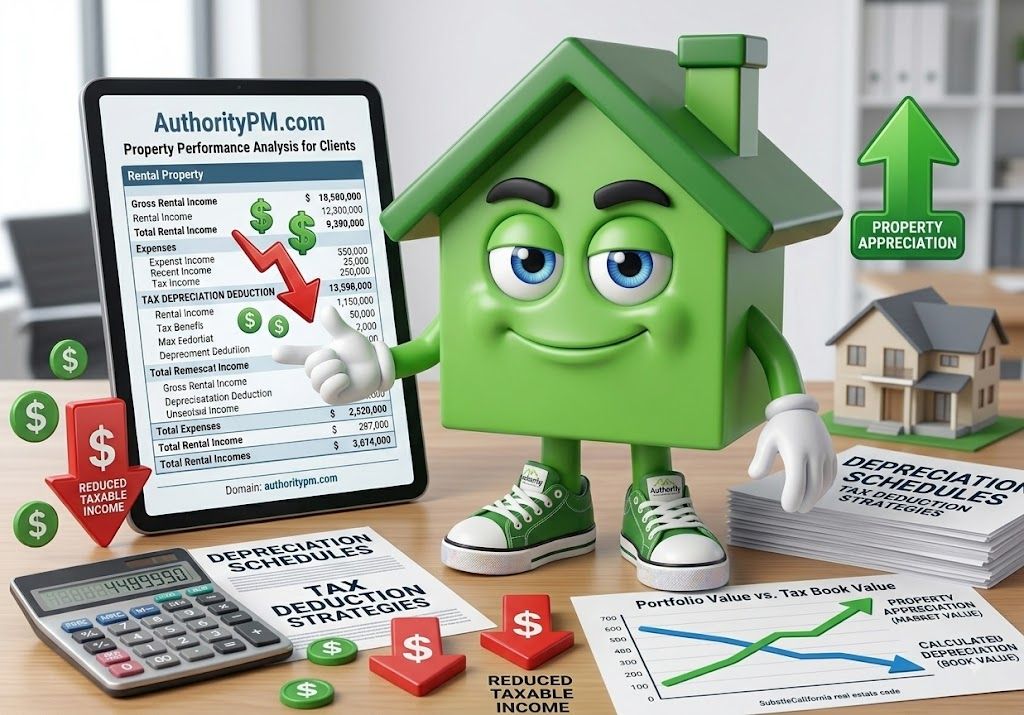
Depreciation can allow a landlord to reduce taxable rental income year after year, even while the rental property itself may be increasing in market value.
That sounds strange at first.
How can a property appreciate in value while the IRS allows you to depreciate it at the same time?
That is one of the reasons rental real estate can be such an attractive long-term investment.
At Authority Property Management, we believe rental property owners should understand not only what their property earns each month, but also the larger financial advantages that can come with owning income-producing real estate.
In this article, we will explain how rental property depreciation works, why it can be so valuable, and why every landlord should be discussing it with a qualified tax professional.
Important: This article is for general educational purposes only. Authority Property Management does not provide tax, accounting, or legal advice. Every owner's situation is different. Always consult your CPA or qualified tax professional regarding your specific circumstances.
💵 What Is Rental Property Depreciation?
Depreciation is a federal income tax deduction that allows property owners to recover the cost of certain income-producing property over time.
The IRS recognizes that buildings, appliances, flooring, equipment, and other physical assets have useful lives. Instead of necessarily deducting the entire cost in one year, taxpayers generally recover those costs through depreciation deductions over specified periods.
For most residential rental buildings using the federal General Depreciation System, the building is depreciated over 27.5 years.
That creates an annual tax deduction that may significantly reduce the taxable income generated by the rental property.
And here is the part many new landlords find surprising:
Your property does not have to actually be losing market value for you to claim depreciation.
A rental home could increase substantially in market value while the owner continues taking allowable depreciation deductions.
📈 Your Property Can Appreciate While You Depreciate It
This is one of the most interesting characteristics of real estate investing.
Imagine buying a rental property in Redding for $450,000.
Over the next 10 or 15 years, rents may rise, the neighborhood may improve, inflation may increase replacement costs, and the property's market value may grow.
The property could eventually be worth considerably more than the original purchase price.
From an investment standpoint, the property appreciated.
But for tax purposes, the depreciable portion of the property may still be generating annual depreciation deductions.
Those two things can happen at the same time.
That means a real estate investor can potentially benefit from:
- Rental income
- Mortgage principal reduction
- Long-term property appreciation
- Depreciation deductions
- Other legitimate rental property tax deductions
That combination is a major reason investors often view real estate differently from many other types of investments.
🏡 You Cannot Depreciate the Land
One important distinction is that landlords generally depreciate the building, not the land underneath it.
Land generally cannot be depreciated because it does not wear out or become obsolete in the same way a building does.
That means the purchase price generally needs to be allocated between the value of the land and the value of the improvements.
For example:
Purchase Price: $450,000
Allocated Land Value: $90,000
Building Basis: $360,000
The $90,000 attributed to land would generally not be depreciated.
The $360,000 building basis generally would be.
Using a simplified 27.5-year calculation:
$360,000 ÷ 27.5 = approximately $13,091 per year in depreciation
The actual first and final year calculations will generally differ because residential rental property uses the mid-month convention. This example is intentionally simplified to demonstrate the concept.
Think about what that means.
The landlord did not necessarily write a $13,091 check that year.
Yet there may still be approximately $13,091 of depreciation expense reducing taxable rental income before considering the owner's other tax circumstances and limitations.
That is why depreciation is commonly described as a non-cash deduction.
💰 Why Depreciation Can Be So Valuable
Imagine that same rental property produces positive cash flow.
After collecting rent and paying operating expenses, the owner has $12,000 remaining for the year before depreciation.
Now assume the property also generates approximately $13,091 of depreciation.
From a cash standpoint, the owner may have received positive cash flow.
From a tax accounting standpoint, depreciation could significantly reduce the taxable income associated with the property and, depending on the owner's circumstances, could potentially contribute to a tax loss.
That does not automatically mean the landlord can deduct the entire loss against wages or other income.
Rental real estate can be subject to passive activity rules, at-risk rules, and other limitations.
But this example demonstrates why experienced real estate investors pay close attention to depreciation.
🟩 Tip: Positive cash flow and taxable income are not necessarily the same number.
🧾 When Does Rental Property Depreciation Start?
Buying a rental property does not necessarily mean depreciation begins on the closing date.
Generally, depreciation begins when the property is placed in service for the production of income.
In practical terms, this usually means the property is ready and available to rent.
For example, imagine you purchase a home in May but spend June and July completing renovations.
If the property becomes rent-ready and is offered for rent in August, August may be the relevant placed-in-service month rather than May.
That distinction can matter when calculating the first year's depreciation.
Good documentation is important.
Rental property owners should retain records such as:
- Closing statements
- Purchase documents
- Improvement invoices
- Contractor receipts
- Appliance receipts
- Renovation records
- Dates the property became available for rent
- Documents supporting the property's tax basis
🔨 Repairs and Improvements Are Not Always Treated the Same
Another important tax concept for landlords is the difference between a repair and an improvement.
Repair costs may sometimes be currently deductible when they keep the property in ordinarily efficient operating condition.
Improvements may need to be capitalized and depreciated over time.
For example, replacing a small damaged component may receive different tax treatment from replacing an entire major building system.
A new roof, for example, is generally treated differently from a small roof repair.
This is one reason good bookkeeping matters so much for rental property owners.
Simply labeling everything as "maintenance" does not determine how the IRS will treat the expense.
Your CPA needs enough information to understand what work was actually completed.
🛠️ Some Rental Property Assets Depreciate Much Faster
The rental building itself may generally have a 27.5-year recovery period, but not every asset associated with a rental property necessarily has the same depreciation schedule.
Certain assets commonly found in residential rentals may have shorter recovery periods.
Depending on the circumstances, these may include items such as:
- Appliances
- Carpeting
- Certain furniture
- Equipment
- Certain land improvements
- Other qualifying property components
This becomes particularly important when an owner makes substantial improvements or purchases a larger investment property.
Instead of assuming every dollar associated with the property must be depreciated over 27.5 years, a qualified tax professional may identify assets that receive different tax treatment.
That leads to a strategy many real estate investors are hearing much more about.
🚀 What Is Cost Segregation?
A cost segregation study analyzes components of a building to determine whether certain costs can properly be classified into shorter depreciation categories rather than remaining part of the building's longer depreciation schedule.
Depending on the property, certain components may potentially be assigned to 5-year, 7-year, 15-year, or other appropriate recovery periods.
The goal is not to create deductions that do not exist.
The goal is to determine when legitimate depreciation deductions may be taken.
Moving qualifying assets into shorter recovery periods can accelerate depreciation deductions into earlier years.
That can potentially improve an investor's current cash flow by reducing current tax liabilities, depending on the owner's individual tax situation.
Cost segregation is not appropriate for every rental property.
Factors that should be considered include:
- Property value
- Depreciable basis
- Cost of the study
- Planned holding period
- Passive activity limitations
- Other income
- Future tax planning
- The owner's overall financial situation
A qualified CPA or cost segregation professional should help determine whether the strategy makes financial sense.
⚡ Bonus Depreciation Can Make This Even More Interesting
Current federal tax law also provides 100% additional first-year depreciation, commonly called bonus depreciation, for certain qualifying property acquired after January 19, 2025, assuming applicable requirements are met.
This does not mean a landlord can simply deduct the entire cost of a residential rental building in the first year.
Residential rental buildings generally remain 27.5-year property.
However, certain qualifying shorter-life assets associated with a rental property may potentially qualify for bonus depreciation.
That makes conversations about asset classification and cost segregation particularly important for investors purchasing or substantially improving rental property.
🟩 Pro Tip: Before making a major rental property purchase or renovation, consider talking with your CPA before the transaction is complete instead of waiting until tax season.
Tax planning can give your professional more opportunities to structure and document transactions correctly before the money has already been spent.
🐻 California Landlords Need to Be Especially Careful
California rental property owners have another layer to consider.
California depreciation rules do not always match federal depreciation rules.
Federal tax law and California tax law may treat certain depreciation deductions differently, including some forms of bonus depreciation.
That means a California rental property owner could potentially have one depreciation calculation for federal tax purposes and another calculation for California tax purposes.
For Redding and Shasta County rental property owners, this distinction is especially important.
Do not assume that a federal tax strategy automatically produces the exact same California tax result.
Your CPA may need to maintain separate federal and California depreciation schedules.
📊 What Happens if Depreciation Creates a Rental Loss?
This is where depreciation becomes powerful, but also more complicated.
Rental activities are generally treated as passive activities for federal income tax purposes unless an exception applies.
Passive losses can be subject to limitations.
Some landlords who actively participate in their rental real estate may qualify for a special allowance that permits up to $25,000 of rental real estate losses to offset certain nonpassive income.
However, that allowance is subject to income limits and other requirements.
Different rules can also apply to taxpayers who qualify as real estate professionals and meet applicable material participation requirements.
Losses that cannot currently be used may potentially be suspended and carried forward rather than simply disappearing.
This is why a statement such as:
"Depreciation will automatically reduce the taxes on your W-2 income."
is an oversimplification.
Sometimes depreciation-related losses may offset other income.
Sometimes they may not.
Sometimes the tax benefit may be carried forward.
The answer depends on the taxpayer's individual situation.
⚠️ What About Depreciation Recapture When You Sell?
Depreciation provides a valuable tax benefit during property ownership, but landlords also need to understand what can happen when the property is eventually sold.
Depreciation reduces the property's adjusted tax basis.
When depreciated real estate is sold for a gain, some of the gain associated with depreciation may receive different tax treatment.
This concept is commonly referred to as depreciation recapture, although the exact tax treatment of real estate depreciation can be more technical than the phrase suggests.
This sometimes leads owners to ask:
"Should I just skip depreciation so I don't have to deal with it when I sell?"
Generally, that is not a good assumption.
Tax basis is generally reduced by depreciation that was allowed or allowable.
In other words, simply failing to claim depreciation may not allow an owner to avoid the tax consequences associated with depreciation they were entitled to take.
That is an important conversation to have with your CPA.
The rules surrounding a future sale, suspended passive losses, capital gains, depreciation, Section 1250 gain, and other planning strategies can become complicated.
The lesson is not that depreciation is bad because taxes may eventually be due.
The lesson is that good real estate investing includes planning for the entire ownership cycle, from purchase through eventual sale.
🧠 Depreciation Shows the Difference Between Cash Flow and Taxable Income
This may be the biggest concept rental property owners should understand.
A rental property has several different measurements of financial performance.
There is:
- Cash flow
- Taxable income
- Equity growth
- Mortgage principal reduction
- Property appreciation
- Operating expenses
- Tax deductions
- Depreciation
These numbers interact, but they are not identical.
A rental property can generate positive cash flow while showing much less taxable income because of depreciation.
A property can appreciate in market value while its tax basis is being reduced through depreciation.
A landlord can also increase equity by paying down a mortgage even though mortgage principal payments are generally not treated as a deductible operating expense.
Understanding those differences helps property owners evaluate rental real estate as a long-term investment instead of simply looking at the rent check that arrives each month.
📁 Good Records Make Good Tax Planning Possible
A CPA can only work with the information an owner provides.
Rental property owners should maintain organized records for:
- Property purchases
- Closing costs
- Improvements
- Repairs
- Appliances
- Flooring
- Roof replacements
- HVAC systems
- Capital projects
- Contractor work
- Major property upgrades
- Other significant expenditures
Keep documentation showing:
- What was purchased
- What work was completed
- When it was completed
- How much it cost
- When the asset or improvement was placed in service
That information may help determine whether an expense is currently deductible, depreciable over several years, assigned to a shorter recovery period, or potentially eligible for another tax treatment.
Poor records can turn legitimate tax opportunities into missed deductions.
🏠 How Professional Property Management Supports Better Investment Decisions
Property management and tax preparation are two very different jobs.
Authority Property Management does not act as your CPA or tax advisor.
What professional property management can do is help owners better understand the operating side of their rental investment.
Accurate rent collection records, organized expenses, documented maintenance, professional vendor coordination, and consistent property oversight can all create a clearer picture of how a rental property is actually performing.
That information can become extremely valuable when an owner sits down with their:
- CPA
- Tax professional
- Financial advisor
- Real estate attorney
- Investment advisor
Rental property should be managed like an investment.
That means understanding income, controlling expenses, maintaining the asset, protecting the tenancy, keeping good records, and making decisions with the long-term performance of the property in mind.
💬 Final Thoughts on Rental Property Depreciation
Depreciation may be one of the most valuable and misunderstood tax benefits of rental property ownership.
A landlord can own a property that is producing income.
The tenant may be helping pay down the mortgage.
The property's market value may increase over time.
And at the same time, the owner may be receiving substantial depreciation deductions for tax purposes.
That combination is one of the reasons rental real estate can be such an attractive asset class for long-term investors.
But depreciation is not something landlords should guess their way through.
The rules surrounding tax basis, land allocation, capital improvements, passive losses, cost segregation, bonus depreciation, California adjustments, and depreciation at the time of sale can become complicated quickly.
Build a good team.
Work with an experienced CPA who understands rental real estate.
And work with a property management company that understands that owning rental property is not simply about collecting rent.
It is about protecting and improving the performance of your investment over the long term.
If you own rental property in Redding, Anderson, Cottonwood, Shasta Lake, Palo Cedro, or the surrounding Shasta County area and would like help managing the day-to-day responsibilities that come with being a landlord, Authority Property Management is here to help.
Looking for Professional Property Management in Redding, CA?
Authority Property Management helps rental property owners protect their investments, reduce day-to-day landlord responsibilities, and manage their properties professionally.
Let us handle the day-to-day property management so you can focus on the bigger picture of building and protecting your real estate investment.
Rental Property Depreciation Calculator
See how residential rental property depreciation may change the taxable income generated by your investment.
Property Details
Rental Income & Expenses
See How Depreciation Changes the Numbers
Want to Know What Your Redding Rental Could Earn?
Get a local rental analysis from Authority Property Management and see what your property may rent for in today's market.
Get Your Free Rental AnalysisShare this post with a friend!
Disclaimer: The content on this blog is for informational purposes only and is not intended as legal or advice. Consult with a qualified professional for specific advice.